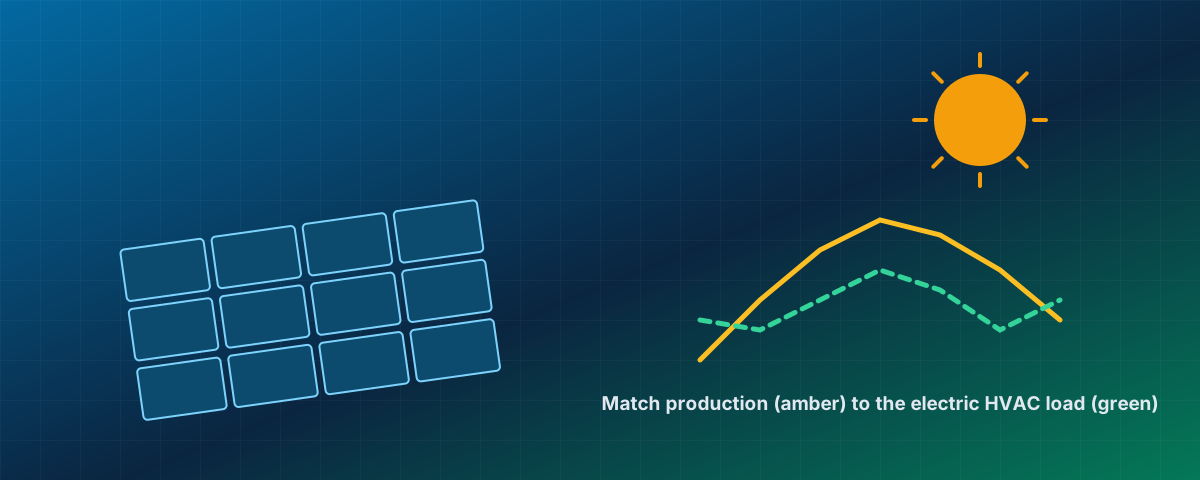
Sizing Solar for an All-Electric HVAC Load
A PVWatts-based workflow for sizing an array to an electrified building — plus roof constraints, seasonal mismatch, and why, under 2026 net-billing rules, 100% offset is often the wrong target.
By the GetVRF editorial team · Updated July 12, 2026 · 13 min read
Start from the load, not the roof
The most common sizing mistake is starting with "how many panels fit?" The right anchor is the building's annual electric consumption after electrification — because pairing solar with VRF changes the load you're sizing against. When you replace gas heat with a heat pump, winter kWh goes up; when you replace resistance or old equipment with efficient VRF, cooling-season kWh usually goes down. Size to the new all-electric load, not last year's mixed-fuel bill.
Practical first step: estimate post-retrofit annual kWh = existing non-HVAC electric load + modeled VRF cooling kWh + modeled VRF heating kWh (heating therms ÷ furnace efficiency, converted to heat, ÷ seasonal heat-pump COP). Our calculator does this screening automatically; a full design uses an hourly energy model.
The PVWatts workflow
NREL's PVWatts is the industry-standard free estimator. The inputs that actually move the answer:
- Location — sets the solar resource (typical-year weather). This alone swings yield 30%+ across US regions.
- System size (kW-DC) — the variable you're solving for.
- Module type & array type — fixed roof-mount is the default for buildings; premium modules bump efficiency slightly.
- Tilt & azimuth — tilt near latitude and a south (180°) azimuth maximize annual kWh; flat commercial roofs often use low tilt with east-west rows to pack more panels.
- System losses — PVWatts defaults to ~14% (soiling, wiring, inverter, mismatch). Keep it unless you have measured reasons to change it.
- DC-to-AC ratio — ~1.1–1.3; higher ratios harvest more in shoulder hours but clip at midday peaks.
PVWatts returns annual and monthly AC kWh. Divide your target annual kWh by the per-kW yield it reports to get the DC size you'd need for a given offset — then reconcile that against what the roof can actually hold.
Why 100% offset is often the wrong target
Under legacy full-retail net metering, oversizing toward 100% annual offset made sense — every exported kWh banked at retail value. Under 2026 net-billing regimes (California's NEM 3.0 and the growing list of states following it), exports are credited at a much lower avoided-cost rate — often 5–8¢/kWh versus 25–35¢ retail. That changes the economics fundamentally:
- Self-consumed solar is worth full retail; exported solar is worth a fraction. The value of an array now depends on how much of its output the building uses in the moment.
- The optimal size is usually below 100% offset in net-billing territory, sized closer to the daytime coincident load so most kWh is self-consumed.
- VRF helps here — its daytime cooling load overlaps solar production, raising self-consumption versus a building whose loads are mostly after dark.
- Storage changes the math again — a battery lets you self-consume evening load from midday solar, pushing the economic size back up. Where storage incentives exist (e.g. California's SGIP), model PV and storage together.
In full-retail-net-metering states (still the case in much of the Mid-Atlantic and elsewhere), 100% offset remains a reasonable target. Check your state's rules first — it's the single biggest input to the sizing decision.
Roof constraints that cap the answer
- Usable area. Rule of thumb: ~100 ft² of unobstructed roof per 1 kW-DC of modern panels. Deduct setbacks, walkways, and equipment.
- Orientation & tilt. Flat roofs give layout freedom but need ballast/attachment engineering; pitched roofs constrain azimuth.
- Shading. Parapets, rooftop units, adjacent buildings, and trees cut yield — and VRF's smaller footprint (vs. big RTUs and gas flues) is a real advantage here, freeing 10–20% more clear roof.
- Structure. Added dead load needs a structural check, especially on older roofs or with ballasted racking.
- Fire code & access. Setbacks and pathways (IFC/IRC) reduce the buildable area — plan them in, don't discover them at permitting.
The seasonal-mismatch problem
Solar production peaks in summer; an electrified building's heating load peaks in winter, when production is lowest and days are shortest. That means an array sized to cover winter heating would massively overproduce in summer (and, under net billing, dump that surplus at avoided cost). Two honest consequences:
- Annual-offset math hides the mismatch. Look at the monthly PVWatts output against monthly load, not just the yearly totals.
- In heating-dominant climates with net billing, the economically optimal array is smaller than the "net-zero" array, and winter grid electricity (ideally on a clean/time-of-use tariff) covers the gap.
Screening rules of thumb
| Situation | Sizing target |
|---|---|
| Full-retail net metering | Up to ~100% of annual all-electric kWh (roof permitting) |
| Net billing (NEM 3.0-style), no storage | ~ daytime coincident load — often 50–80% of annual |
| Net billing + storage | Higher; size PV and battery together to shift solar into evening use |
| Heating-dominant climate | Watch winter months explicitly; annual offset overstates value |
These are starting points for a conversation, not a design. The real number comes from an hourly model that overlaps your load shape with local production and your exact tariff — which is what a good solar-VRF proposal should show you.
Frequently asked questions
How many solar panels do I need for a heat pump or VRF system?
Size to the building’s post-electrification annual kWh, not a panel count. Estimate the new all-electric load (non-HVAC electric + modeled VRF heating and cooling kWh), then use PVWatts yield for your location to convert a target offset into a DC array size — capped by usable roof area of roughly 100 ft² per kW.
Should I size solar to offset 100% of my usage?
Only under full-retail net metering. Under 2026 net-billing rules (NEM 3.0 and similar), exports are credited far below retail, so the optimal array is often sized to the daytime coincident load so most output is self-consumed — unless you add storage, which raises the economic size.
What is PVWatts and why use it?
PVWatts is NREL’s free, industry-standard production estimator. You enter location, system size, tilt, azimuth, and losses, and it returns monthly and annual AC kWh using typical-year weather — the baseline for matching an array to a building load.
Why does solar not fully cover winter heating?
Solar production is lowest in winter, exactly when an electrified building’s heating load peaks. Annual totals hide this seasonal mismatch, so compare monthly production to monthly load; in heating-dominant climates the grid (ideally a clean or time-of-use tariff) covers the winter gap.
Sources
- NREL PVWatts Calculator (pvwatts.nrel.gov) and NREL PV performance modeling documentation
- CPUC Net Billing Tariff (NEM 3.0) and state net-metering rules via DSIRE
- International Fire Code / IRC rooftop PV setback & access requirements
- GetVRF engine assumptions & methodology (calculator page)
Educational content — actual system performance, costs, and program terms vary by building and market. Get site-specific engineering and bids before deciding.